

(If you're very impatient, just listen to the first audio halfway through. I won't be offended. Actually, I will be, but I'll never know.)
(Update) Friends were unsure about what to expect from the text, so here is what Claude thinks the TLDR is: The article explores the paradox of Sappho's legacy — how one of antiquity's most celebrated poets survives only in fragments, with just one complete poem from nine original books of poetry that made ancient listeners weep and demand to learn her songs before dying. The author argues that this fragmentary survival actually liberates us from seeking an "authentic" Sappho (which never existed even in her lifetime, as oral traditions constantly varied), and instead proposes using AI to create contemporary versions that can actually move modern audiences. Taking Fragment 147 ("someone will remember us in the future"), the author demonstrates this approach by having an LLM expand the fragment into fuller verse, then transforming it into a modern pop song with AI-generated music and voice, complete with fictional album art and explanatory videos. The piece contends that every generation has always projected their own desires onto Sappho's gaps — Victorians made her straight, the 1960s found sexual liberation, academics read resistance — and that using AI for these reconstructions simply accelerates and democratizes this eternal process of resurrection through reinterpretation, ultimately fulfilling the fragment's prophecy about being remembered in ways Sappho could never have imagined.
I have this thing about Tom Stoppard's plays. In "The Invention of Love," there's this depressing observation: we have more words from Ovid — who basically spent his exile posting weather complaints — than from Sappho, who everyone in antiquity agreed was one of the greatest poets who ever lived. This fact makes me want to scream into a pillow. Here's Sappho, the actual Tenth Muse according to Plato, and what do we have? Scraps. Fragments quoted by pedantic grammarians. Bits of papyrus that ancient Egyptians used to wrap their mummies. The margins of other people's texts where someone jotted down a line they liked.
The woman revolutionized poetry around 630 BCE on Lesbos, a Greek island near the coast of modern-day Turkey, and a day's travel by ship from ancient Troy. While Homer was all war and glory and masculine chest-thumping, Sappho wrote about what jealousy feels like in your body — the actual physical symptoms of desire, the way your tongue goes dead when you see someone you want. Solon heard one of her songs at a party and immediately demanded his nephew teach it to him, saying, "So that I may learn it and die." That's not a normal reaction to poetry. That's someone having their entire nervous system rewired by art.
And yet. Nine books of her poetry circulated in antiquity. We have one complete poem. One. Plus another nearly-complete one they found in 2004, which must have been the best day ever for whoever was sifting through that particular pile of ancient garbage.
A fragm
Classical texts reach us like light from dead stars—fragments of brilliance traveling across centuries of darkness. And so did Fragment 147, the starter culture we will work from:
I tell you
someone will remember us
in the future.
Basically, "I say that someone will remember us even later." The power here isn't just the words. It's everything we don't know. Who's the "us"? A lover about to leave? Her whole crew of poetry girls? Everyone alive on Lesbos that Tuesday? We have no idea. The context vanished with the rest of the poem, leaving us with this perfect little prophecy that turned out to be true in the weirdest possible way.
Because someone did remember her. Lots of someones. For 2,600 years. Just not the way she probably imagined — not through complete works passed down lovingly through generations, but through fragments that drive scholars insane with their incompleteness. The fragment becomes its own commentary on survival. Meta as hell.
Missing emotions
Here's the thing about reading ancient poetry: it requires a particular kind of mental athletics that most people reasonably don't want to perform. You need to understand meter, get the references, and mentally reconstruct what's missing like some kind of literary detective. But the real problem? The emotional inaccessibility. These poems weren't meant to be read in your head while you're on the subway. They were sung. Performed. They made people cry.
The music problem is especially brutal. When musicologists reconstruct ancient Greek music, it sounds — and I'm being generous here — like someone torturing cats. Technically accurate, emotionally (at least to me) dead. Yet we know these songs absolutely destroyed people. Solon's reaction wasn't unique. People would learn Sappho's songs and sing them at parties for centuries, passing them down like treasured recipes or family stories.
But it's not authentic!
This is where it gets interesting. In Sappho's time, poems lived through reperformance. She'd sing something, her circle would learn it, they'd sing it elsewhere, and so on. The Sapphic stanza — that intricate pattern of long and short syllables she pioneered — worked like an error-correction code. Mess up the rhythm and everyone would notice. The meter, the melody, and the Greek language's own patterns all created overlapping systems that preserved the general structure while allowing for variation. There was writing as a preservation method, but its role was likely minor.
When Alexandrian scholars finally compiled everything three centuries after Sappho died, they complained about all the variants between different versions. Even with writing, the poems had evolved differently in various places. Think about it: Sappho herself probably never sang the same song exactly the same way twice. What the Alexandrians eventually decided was "official" was just their best guess from multiple divergent traditions, each maybe preserving 90% of the original — but not the same 90%.
This historical reality is liberating. It means there never was an "authentic" Sappho to recover. As one scholar said — and this quote makes me want to high-five them through time — "Because we have so little of her work, because we know so little of her life, she simply becomes this sort of empty space, where you can paint in whatever it is that you want." (from Sappho: Love & Life on Lesbos, Margaret Mountford, BBC)
The part where it gets weird (good weird)
So I thought: what if we stop trying to be archaeologists and start being artists? What if we use AI not to "recover" Sappho but to make her sing in a way that actually moves people now, today, in our particular moment of history? I fed Fragment 147 to an LLM. These things have probably absorbed every word ever written about Sappho — every academic paper, every speculative reconstruction, every terrible undergraduate essay, every pirated book. Yeah, Google Books is probably not used to train Gemini, sure. An LLM's guess at what might have surrounded the fragment is probably as informed as any human speculation. Through a series of prompts, I had it expand the fragment:
I tell you
someone will remember us
in the future—

when other women walk these olive groves,
when the altar stones have cracked with age,
when no one living knows our faces.

You are leaving. Your eyes
avoid mine, your hands shake
as you fold your cloak.

But I have pressed these words
into your skin like sacred oil—
they will outlive the stars.

Girls not yet born will sing them
when they too must part,
recognizing in our ache their own.

In Sardis, when afternoon light
finds you at your loom,
you'll hum without thinking
this melody I taught you.

Someone will ask: who gave you that song?
And you will say my name.
And they will remember us.
After messing around with prompts some more, we transform the expanded poem into actual contemporary pop:
Here's what kills me about this: it's using every trick in the modern songwriting playbook. Verse-chorus-verse-chorus-bridge-final chorus — the architecture you've heard ten thousand times. The dawn departure scene with its packed belongings and oil lamps gives you that concrete narrative specificity that modern listeners need to care. The pre-chorus hits you with "Listen close, my dear" because we need our tension-and-release dynamics, or we get bored. The language does this thing where it bounces between trying to sound profound ("When these stones are dust") and just talking to you ("You're gonna ask you why"), which is basically how all contemporary pop works — accessibly deep, or deeply accessible, whatever.
Current AI music models just make up everything — the music AND the voice. It's like playing with a supernatural mixing board where you keep regenerating until something doesn't sound like garbage. But here's where it gets fun: once you land on a voice that doesn't hurt your teeth, you can extract it. Make a copy. And then — this is the part that makes me feel like we're living in the matrix — you can have "Sappho" explain what her own song means:
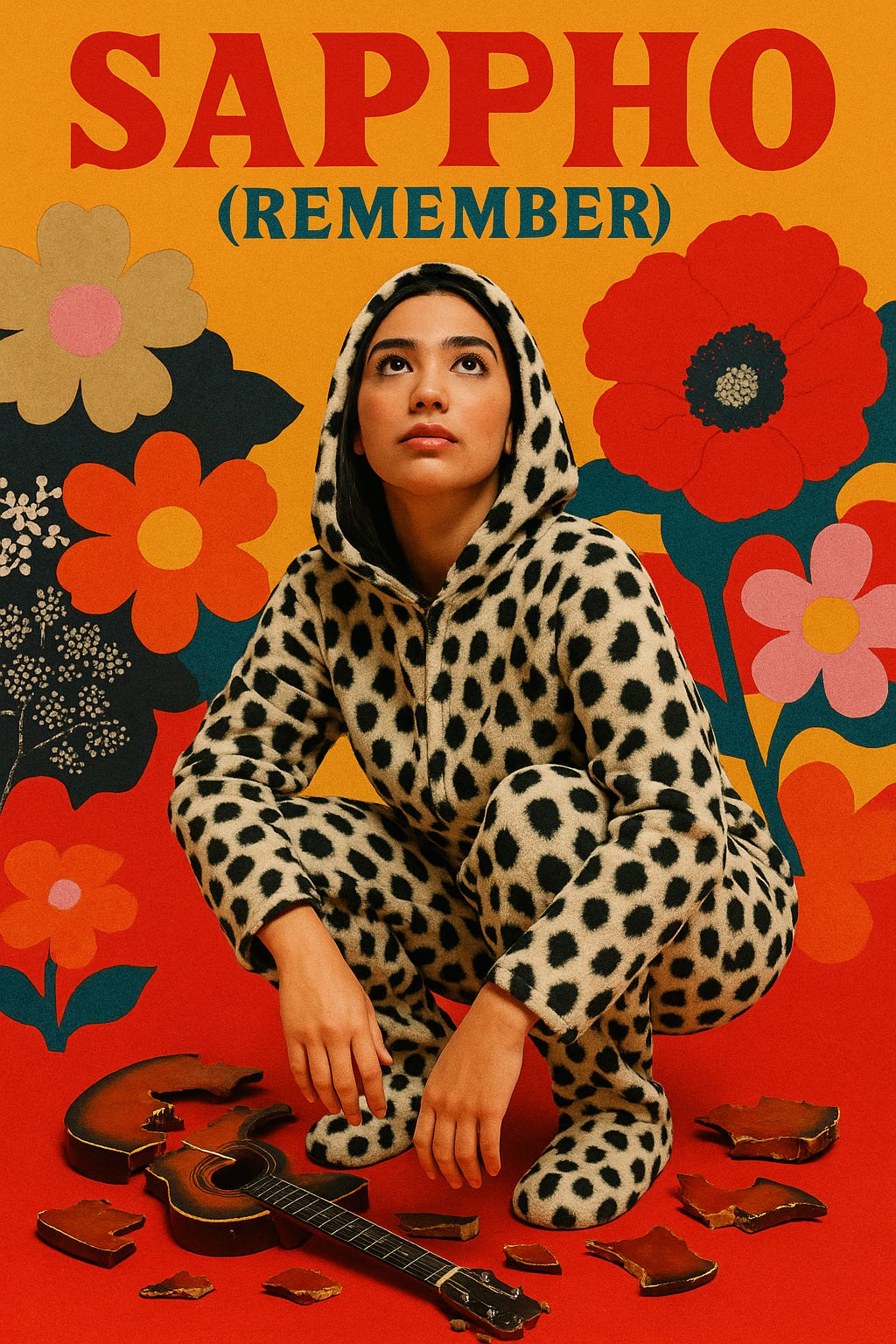
We need an album cover, obviously. So I had the AI imagine what Sappho looked like, adding some style preferences because why not. Fun fact: Sappho apparently loved luxury items. What's more luxurious than a leopard skin onesie? Nothing. The answer is nothing. You saw the result above.
And because we live in the attention economy and everything must be content, I animated the entirely fictional album cover and had fake Sappho perform something deliberately polarizing to make the virality machine go brrr:
Discuss
When we use AI to complete Sappho's fragments, we're not discovering ancient Lesbos. We're revealing ourselves — our desires, our assumptions, what we think poetry should do. Every prompt encodes what we want. Every training dataset contains what we believe. The voice that emerges is simultaneously ancient and absolutely contemporary. But here's the beautiful part: this is what every generation has done with Sappho. The Victorians made her straight and marriageable. The 1960s found sexual liberation. The 1980s academic feminists read her as documenting women's resistance communities. Everyone projects their preoccupations onto those gaps in the papyrus. What's different now is the scale and speed. AI can generate infinite Sapphos, each slightly different, each potentially valid. We can create not just textual completions but full multimedia experiences — songs, voices, portraits, videos. The fragments become seeds for endless gardens.
Fragment 147's promise — "someone will remember us in the future" — hits different in our age of digital reproduction. Sappho got her immortality, but in the weirdest possible form: not through complete works faithfully preserved but through fragments endlessly recombined, first by humans, now by machines trained on everything humans ever wrote.
The question isn't whether we should use AI to resurrect ancient voices. We've always been in the resurrection business. The Alexandrian scholars did it. Every translator does it. The question is whether we can stay conscious of what we're doing: not recovering the "authentic" Sappho (who never existed as a fixed entity even in her own lifetime) but creating new Sapphos who speak to our moment while carrying something essential forward from the past. Across more than two thousand years, someone does indeed remember her. And through remembering, makes her sing again. Which is probably what she wanted all along.
If 100+ people actually care about this (and subscribe), I'll make a whole Sappho podcast, and it'll either be transcendent or completely unhinged, possibly both.